Ideyo is the autonomous product builder that decides before it builds.
Built for web apps · mobile apps · SaaS · internal tools.
Starting Discover. I’ll look at how salons take bookings in each city today, what a no-show costs them, and which payment methods their clients actually use.
Montréal salons already book online, but no tool takes a deposit by mobile money. In Dakar most bookings happen on WhatsApp, and a no-show costs a chair for an hour. Scoring:
| Criterion | Score |
|---|---|
| Problem severity | 4 |
| Reachable market | 4 |
| Competition (inverted) | 3 |
| Differentiation | 4 |
| Technical feasibility | 5 |
| Regulation (inverted) | 4 |
| Time to prototype | 3 |
| Average | 3.9 / 5 |
The spec is ready: 8 core features, 14 user stories, a data model and a design brief. Approve to start the design, or tell Ideyo what to change.
A run is active. Send queues your message until the current task finishes.
Most products that fail were built well enough. They fail because too few people needed them. When CB Insights read the post-mortems of 431 venture-backed startups that shut down since 2023, the most common reason was poor product-market fit, cited for 43% of them. And teams usually find out after they have built: months of design and code spent on a question that a week of research could have answered.
The Wright brothers worked the other way round. In the autumn of 1901, in the back room of their bicycle shop in Dayton, Ohio, they built a small wind tunnel and tested as many as two hundred wing shapes in it. In 1902 they flew their new glider between seven hundred and a thousand times at Kitty Hawk. Only then did they build an engine. On 17 December 1903 the Flyer stayed up for twelve seconds and 120 feet, and the hard questions had already been answered on the ground.


Ideyo runs that loop for software. It decides first: a sourced opportunity study and a verdict, GO, PIVOT or NO-GO, before a line of code is written. Then it specifies, designs, builds test-first and ships a pull request into your own GitHub repository. You step in only at the two moments that matter, approving the spec and approving the design, and you can do both from your phone.
Nothing ships unchecked. Before the pull request is opened, every project goes through its tests, a design-fidelity check against the screens you approved, a code review and a security review, each written up as a document you can read. In 1969 the Apollo flight software was printed, read and tested before it flew; Ideyo keeps the same habit, at the scale of a small team.

Every stage ends in documents you can read, keep and forward to a client. These come from a sample project: a booking app for hair salons in Montréal and Dakar.
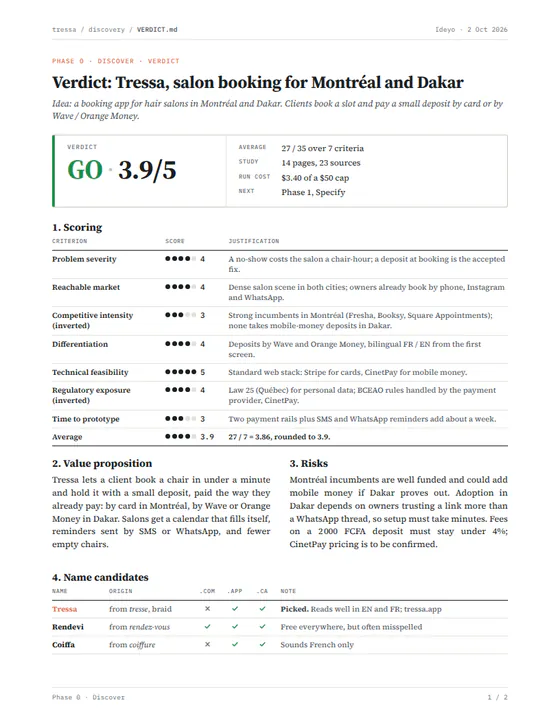
Verdict
GO at 3.9/5, with the scoring, the risks and the name
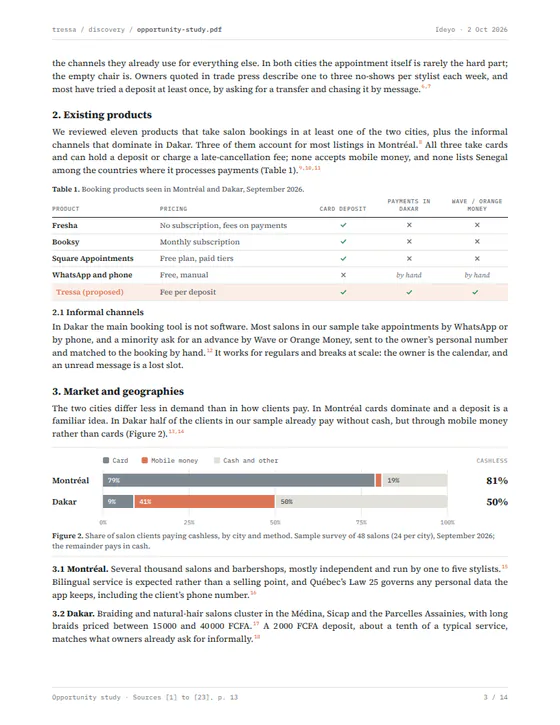
Study
A 14-page sourced study: competitors, markets, payment habits
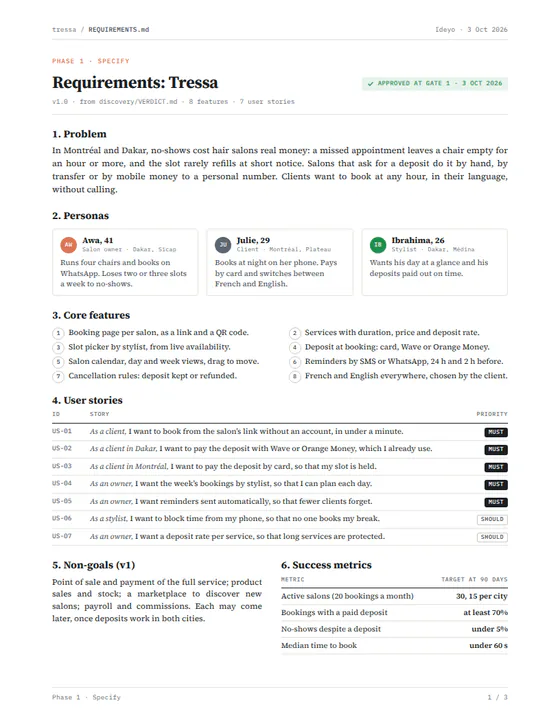
Spec
Personas, 8 core features and the user stories, approved at Gate 1
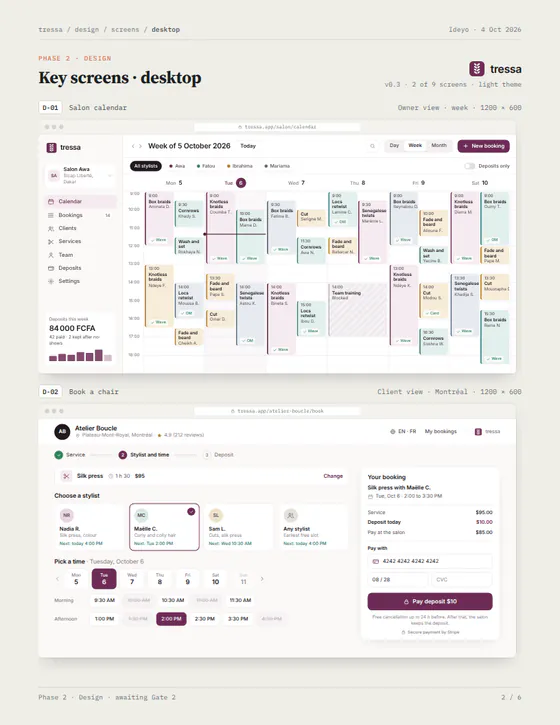
Design · desktop
The salon calendar and the booking page
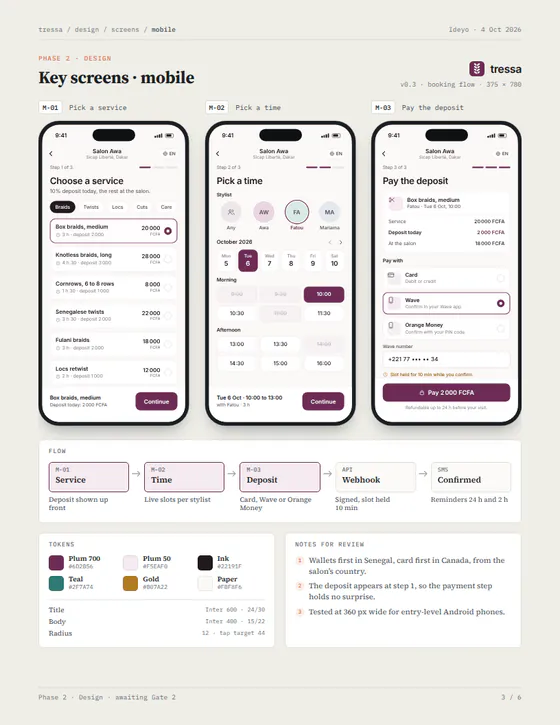
Design · mobile
The booking flow, down to the Wave or Orange Money deposit
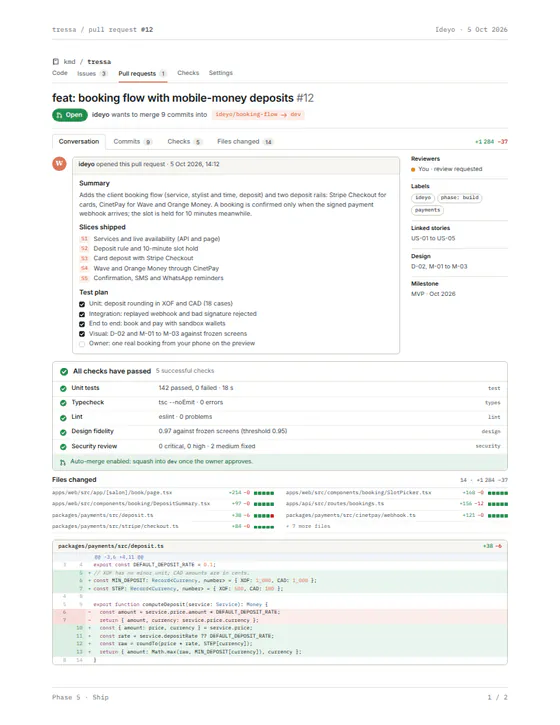
Pull request
A pull request to dev, every check green
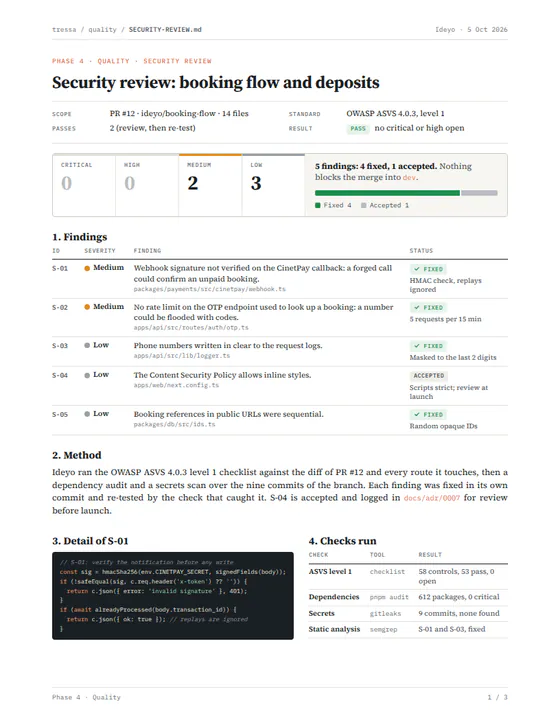
Security
0 critical, 0 high, every finding closed
What can you ask Ideyo? Anything you would brief a small product team on: a client project, a side project, an internal tool, an idea you are not sure about. A few examples:
Booking
Property management
Pharmacy
B2B quotes
Education
NGO
Honest answer
Field service
Client project
Restaurant
SaaS
Who knows?
Your keys, any model. Ideyo works with Claude, GPT, Gemini, Mistral, DeepSeek and everything on OpenRouter. Bring your own API key and you pay the provider directly, at its list price, with nothing added by us. Then pick a model for each stage: the strongest reasoner where judgement matters, a fast one where volume does.
| Stage | Model | Why |
|---|---|---|
| 0 · Discover | Claude Opus 5.5 | Judgement and sourced research |
| 1 · Specify | GPT-6.1 Sol | Long, structured documents |
| 2 · Design | Claude Opus 5.5 | Taste, and HTML and CSS that hold up |
| 3 · Build | GPT-6.1 Sol | Volume of code, written test-first |
| 4 · Quality | Gemini 3.1 Pro (preview) | A second opinion from another lab |
| 5 · Ship | Gemini 3.8 Flash | Fast and cheap for the last mile |
- Budget caps. Set a cap per project. Every call is priced as it happens, and the run stops at the cap, never after it.
- Sealed keys. Keys are encrypted at rest with AES-256-GCM, checked with one cheap call, and never shown again: only their last four characters.
- Your code lives in your GitHub. Ideyo pushes a branch and opens a pull request in your repository. It never keeps the only copy.
Pay by card, or by mobile money. Plans and one-off purchases are paid by card, in US dollars or euros. In the UEMOA zone, a study or a managed project can also be paid in CFA francs with Orange Money, Wave or MTN MoMo, depending on your country, through CinetPay.
- Study
- $49 · €45 · 19,900 FCFA
- Managed project
- $390 · €359 · 199,000 FCFA
Start free. Discover and Specify are free with your own key or the demo model, for one open project. Atelier ($39 a month) runs the full pipeline to the pull request; Studio ($129 a month) is for agencies with many client projects. No subscription? Buy a single study for $49.
Start with a question, not a codebase.
Describe an idea in a paragraph and Ideyo comes back with a sourced verdict. The demo model walks the whole pipeline without any key, so you can see every stage before you spend anything.
Built with the Ideyo pipeline. Ideyo grew out of a working factory: the same stages, run every week by its maker on his own products. These products went through it, and all of them are live today.
Stela stela.world
A digital museum of the human imprint: what we built, discovered, imagined, loved and lost, on every continent.
Gulpes gulpes.com
A studio of practical digital products for growth, learning and real life.
Ciney Labs cineyl.com
A studio that builds custom software and AI systems, from prototype to production.
Embertree embertree.app
A private home for a family’s stories, photos and family tree, shared by relatives across countries.
Pilume pilume.ca
Medication schedules drafted by AI and validated by a pharmacist before they reach the patient, in a pilot.
douare.dev douare.dev
The portfolio of Mohamed Douaré, the platform and applied AI engineer who runs the factory.
Who builds Ideyo? Ideyo is made in Montréal by Mohamed Douaré, an independent product builder who runs the same pipeline for his own products. Many of the next useful products will come from freelancers, small agencies and founders without a technical co-founder, in Dakar, Lyon and Abidjan as much as in San Francisco. Ideyo exists to give them what a good product team gives: an honest answer first, then careful work.
Let’s build what deserves to exist.